



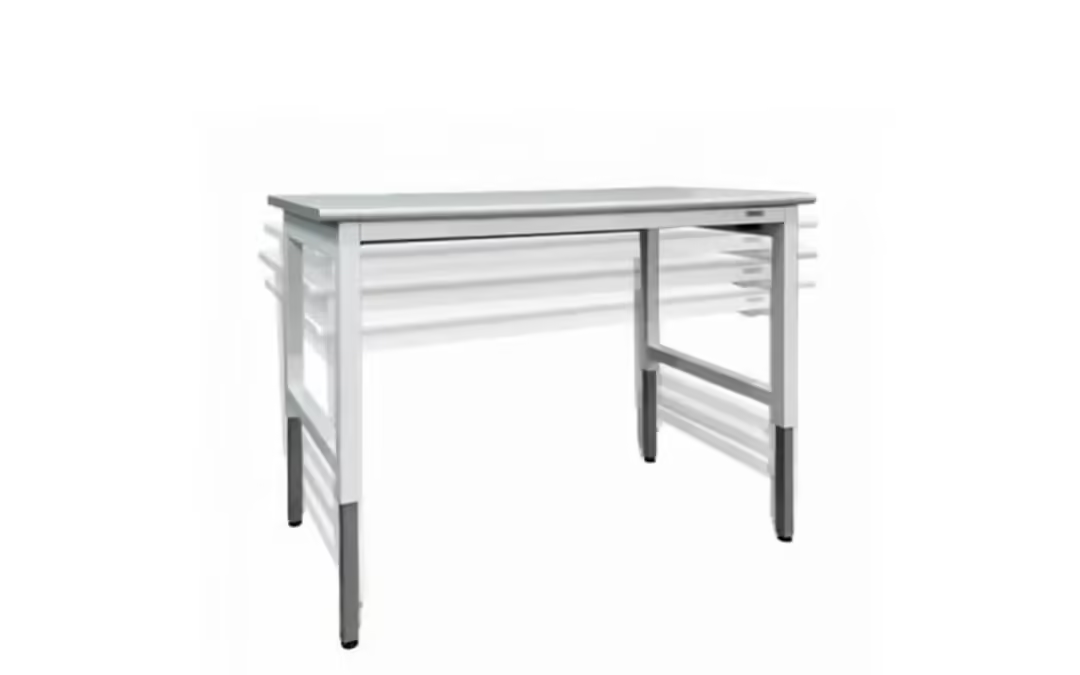
Adjustable height modular lab bench systems make sense when a research lab must change work height, utility access, and bench layout without rebuilding the room. A fixed casework run is the right choice for a stable method and a fixed instrument. It is the wrong choice when people, procedures, and equipment keep moving. The decision is not whether a bench can rise and fall. It is whether height, modularity, services, and reconfiguration will still be right after the next study starts.
Talk to a Design Specialist about your lab bench layout
This guide is for facility planners, lab managers, and engineers who are about to specify benches for a research or analytical lab. It gives a decision framework, not a catalog of frames. If you already know you need a production station and only need the adjustment mechanism, use the height adjustable industrial workstation guide instead.
When Adjustable Height Modular Lab Bench Systems Earn Their Place
Start with the work, not the furniture line. A modular lab bench system earns its cost when at least two of these conditions are true for the next three to five years.
- More than one person uses the same bench, and seated and standing work both happen there.
- The method, instrument, or sample flow is expected to change more than once.
- Power, data, or gas must stay usable when the work surface moves or the bench is relocated.
- The room must be reconfigured without cutting into fixed casework or waiting on a construction project.
If none of those are true, a fixed bench is simpler. Fixed casework costs less to install, hides services in the wall, and does not depend on a lift mechanism. Specify it when the assay, the instrument, and the operator posture are stable.
Shared posture is the clearest trigger. A NIOSH-funded pipetting study found that work-surface height changes shoulder strain, thumb effort, and neck flexion, and that one fixed height cannot serve every task well. The authors advised setting bench height to the pipette tip with the hand at elbow height while standing, and they advised against seated pipetting. That is one task. A research bench that also holds a keyboard, a balance, and a small instrument needs a height the team can actually change. Read the study on the CDC Stacks record of the pipetting surface-height study.
OSHA describes ergonomics as fitting the job to the worker so awkward posture and repetition are less likely to cause musculoskeletal disorders. In a lab, that fit is a specification item. It belongs in the bench decision, not in a later comfort memo. The agency states that position on its ergonomics hazard-control page.
Separate Height, Modularity, Utilities, and Reconfiguration
Buyers often treat “adjustable” and “modular” as one feature. They are four different decisions. Score each one before you pick a platform.
| Decision. | What it changes. | Specify it when. | Skip it when. |
|---|---|---|---|
| Height adjustment. | Work-surface height for the person and the task. | Several people share the bench, or both sit and stand work occur. | One operator and one standing height are fixed. |
| Modularity. | How frames, uprights, shelves, and storage combine. | The same bench family must serve more than one method. | The layout will not change and accessories are already set. |
| Utility access. | Where power, data, and gas stay reachable. | Services must move with the bench or stay clear of the work zone. | Wall services already land where the work happens. |
| Reconfiguration. | How fast the room can be rearranged. | Programs, headcount, or instruments change within a few years. | The lab is a single long-lived installation. |
A bench can be height adjustable and still be a poor system. If the power strip is fixed to the wall, raising the surface pulls cords tight. If shelves are bolted to a chase that cannot move, the “modular” frame is only a table with options you cannot use. Score the four decisions together.
Manual and motorized adjustment answer different problems. Manual ranges, often set in fixed increments, work when height changes between shifts or between projects. Motorized travel is worth specifying when height changes several times a day, when the bench is shared, or when a loaded surface should not be lifted by hand. Workplace Direct Drive holds position with the power off, because each leg encloses a leadscrew rather than hanging the surface on a belt. The height adjustable workstation page states 14 inches of travel in two standard ranges, 500 lb evenly distributed on stationary and mobile units, and 750 lb on three-leg units.
Do not treat those numbers as a lab load rating for your instrument. Add the instrument, the surface, the fixtures, and the person-applied force, then ask for the configuration that carries that load. A vibration-sensitive balance or mass spectrometer may also need a stiffer frame than a general prep bench, even when the pound rating looks sufficient.
Match the System to the Research Task
Research labs rarely have one bench type. Split the room by task before you standardize on a single frame.
Prep and shared technique benches
Pipetting, weighing, kit prep, and write-up are the tasks that benefit most from a real height change. People of different stature share these benches, and the work moves between standing and a short seated stretch. A motorized surface with a clear reach zone is usually the better fit. Keep overhead shelves shallow so a taller operator is not forced into a low set point just to see the work.
Instrument and analytical benches
Chromatographs, mass spectrometers, and similar instruments care more about stability, service access, and utility placement than about a daily height change. Many of these benches should be specified once, at the service height the vendor requires, and then left alone. Use the gas chromatography bench specification guide when an instrument manual sets clearances. Put adjustability on the adjacent prep position, not under a sensitive detector, unless the instrument maker confirms the travel is acceptable.
Benches that will be rearranged
Grant-funded labs, core facilities, and scale-up groups move people and instruments. Mobile frames, loose service whips, and a shared accessory system beat a wall of fixed casework. Mobility is not free. Casters must lock, the floor must be rated for the point load, and gas or vacuum lines need a planned disconnect. If the bench will move once a year, a stationary frame with levelers is usually stiffer and simpler.
For a broader view of how instruments, utilities, and sample flow share one room, see the lab automation infrastructure guide. That article covers the automation path. This one stays on the bench decision that comes before automation hardware.
What to Specify Before You Compare Benches
Write these items down before you request a quote. A vendor cannot judge fit from a room drawing alone.
- Name the tasks at each bench, and whether each task is seated, standing, or both.
- List every person who will use it, or state that the bench must cover a shared stature range.
- Record the tallest instrument, its service clearance, and any vibration or level limit from the maker.
- Mark power, data, gas, vacuum, and drain, and whether each service must travel with the surface.
- State how often the bench will move or be rebuilt, and who is allowed to do that work.
- Set the surface material from the reagents and the cleaning method, not from a catalog photo.
- Note cleanability. Enclosed lift hardware matters in labs where exposed belts collect dust or residue.
Surface choice is its own specification. Epoxy resin and phenolic resin behave differently under solvents, heat, and impact. The work surface options page is the place to match a top to the chemistry. The chemical resistant countertops guide walks through reagent, edge, and heat questions for analytical labs. Do not let a height mechanism hide a surface that cannot survive the method.
Utility routing deserves the same attention. StandardPLUS-style uprights carry power, data, and specialty gas in a vertical chase, which keeps cords off the work surface. That is useful on a lab bench only if the chase still leaves knee clearance and does not block the instrument’s rear service panel. A StandardPLUS workstation is one way to get that overhead access on a manually adjustable frame. It is not a substitute for a motorized shared bench when height changes through the day.
Storage should follow the same logic. Drawer banks and cabinet pedestals hold consumables at the point of use, but a pedestal that braces the frame can also block the lift or the seated knee zone. Confirm that any cabinet still allows the full travel you specified. The storage workstation configurations show how cabinets and instrument carts are arranged when storage is part of the bench rather than an afterthought.
How Reconfiguration Changes the Lab Over Time
The expensive mistake is designing the first experiment only. Research groups add a collaborator, swap an instrument, or split one bay into two. A modular system pays off when those changes reuse frames, uprights, and surfaces instead of sending casework to surplus.
Plan the reuse rules in the specification:
- One frame family, so shelves, uprights, and power accessories move between benches.
- A service strategy that uses whips or overhead drops, not hard pipe buried in a chase you cannot open.
- A map of which benches may move and which instrument benches stay put.
- A named owner for layout changes, so ad hoc moves do not defeat level, load, or grounding.
Fixed casework still wins in rooms with heavy wet services, fume hoods tied to the building exhaust, or a layout that has been stable for years. Use modular benches beside that fixed core, not as a replacement for it. The laboratory applications page shows how bench types sit next to hoods and sinks in real lab layouts. The research applications page is the matching view for R&D rooms where the work itself changes.
Lead time belongs in the same plan. Workplace Modular Systems builds in Londonderry, New Hampshire, and standard configurations are quoted with a domestic lead time, typically four to six weeks. Custom utility panels, special surfaces, or an engineered layout take longer and should go through a design review rather than a self-serve cart. The engineered solutions path is the right one when the bench has to meet a building constraint the standard range does not cover.
A Short Decision You Can Defend
Use adjustable height modular lab bench systems when shared posture, changing methods, or movable services are real. Use fixed benches when the task, the instrument, and the operator height are stable. Use motorized travel when the surface must move often under load. Use manual adjustment when height is set per project and then left alone.
Write the four scores, height, modularity, utilities, and reconfiguration, into the bid package. Ask each supplier to answer those four items with a range, a load basis, a service diagram, and a statement of what can be rearranged later. A brochure photo of a bench that goes up and down is not a system.
Workplace Modular Systems designs, builds, and installs these benches in New Hampshire. A design specialist can tell you when a standard height-adjustable frame is enough and when the lab needs an engineered layout. Bring the task list, the instrument constraints, and the service plan to that conversation.
Request a quote for your lab bench specification
Frequently Asked Questions
When should a research lab choose an adjustable bench over fixed casework?
Choose an adjustable bench when several people share the station, when seated and standing work both occur, or when the method will change. Keep fixed casework for stable instruments, wet services, and layouts that will not move.
Is modular the same thing as height adjustable?
No. Height adjustment changes the work surface. Modularity is the ability to reuse frames, uprights, shelves, and storage as the lab changes. A bench can have one and not the other. Specify both only when you need both.
How much height travel does a shared lab bench need?
There is no universal lab height. Size the range to the people and the tasks, then check it against the instrument’s service height. Workplace Direct Drive provides 14 inches of travel in two standard ranges. Confirm the range against your own operator and equipment list before you order.
Can a height-adjustable bench carry analytical instruments?
It can when the load, stiffness, and vibration limits are specified for that instrument. Do not place a vibration-sensitive detector on a moving bench unless the instrument maker accepts it. Many labs keep analytical instruments on a fixed bench and put adjustability on the prep bench beside them.
What should be in the quote request?
Include the task list and whether use is seated or standing. Add the shared stature range, instrument clearances, and the services that must move with the surface. Also note the surface chemistry and how often the bench will be rearranged. Those items decide the system. A model name does not.