



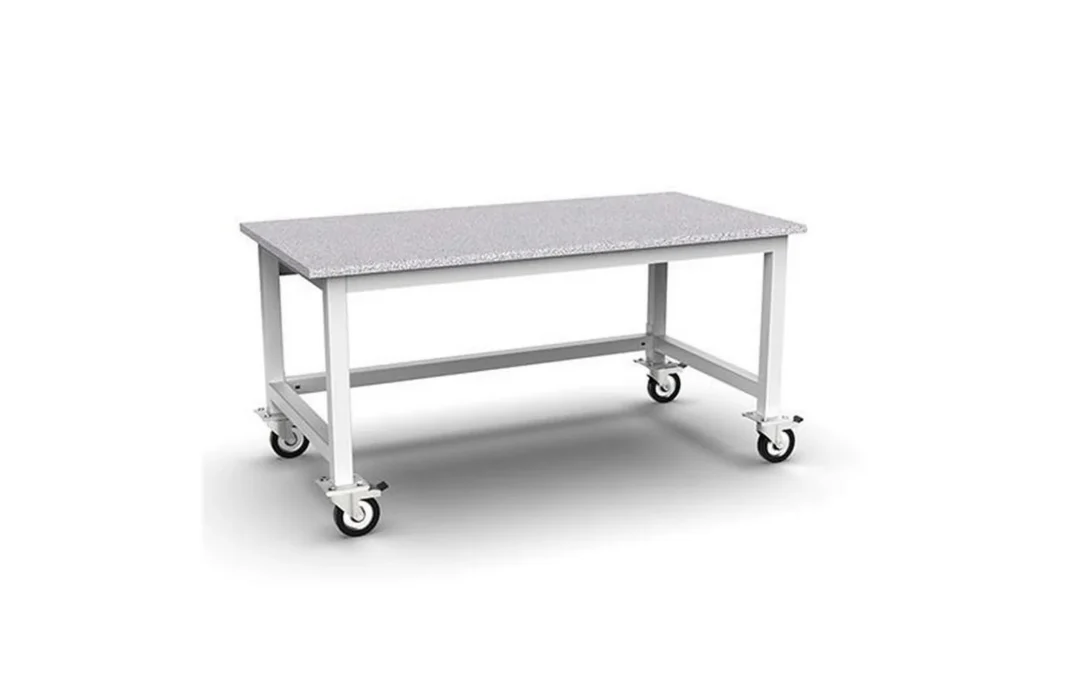
Clean room carts move supplies, tools, components, and work in progress through environments where mobility must not undermine process control. The right clean room carts are selected by starting with the room and workflow, then specifying materials, surfaces, casters, cleaning, and load requirements—not by choosing a cart based on appearance alone.
Discuss your cleanroom material-handling requirements
What Should a Clean Room Cart Do in Your Process?
A cart is part of the material path. It may carry incoming supplies, components between process steps, tools for maintenance, or finished items toward packaging. Each use creates different requirements. A cart that works for moving sealed containers between rooms may not suit frequent handling of exposed product or delicate instruments.
Start by describing the job in operational terms:
- What travels? List the items, containers, trays, instruments, or assemblies that the cart will carry. Note their size, weight, fragility, and whether they are covered.
- Where does it travel? Map rooms, pass-throughs, doors, elevators, corridors, and any boundary where staff transfer material or change handling practices.
- How often does it move? A cart used for occasional replenishment has a different duty pattern from one pushed repeatedly through a production shift.
- Who handles it? Consider operator height, pushing distance, turning, docking, loading, and unloading. Include the people who will use and clean the cart.
- What happens at the destination? The cart may be parked, staged, cleaned, unloaded, or used as a temporary presentation surface. Define which activities are permitted.
Write down the cart’s intended use and limits. For example: “Move closed component totes from the material airlock to assembly; no exposed product; park at the marked station; clean with the approved room procedure.” Specific use statements help prevent a general-purpose cart from drifting into tasks it was never designed to support.
How Does the Room Classification Affect Cart Selection?
There is no single cart specification that fits every cleanroom. Room classification, product sensitivity, process controls, and facility procedures determine what materials and practices are acceptable. Confirm the applicable room and process requirements with the facility quality, engineering, or contamination-control team before asking a supplier to quote.
Clarify at least four boundaries:
- Room and process: Identify the actual room classification or cleanliness requirements, and whether the cart will enter one zone or several.
- Product exposure: State whether the cart carries sealed packages, covered trays, exposed components, or tools that contact product.
- Transfer procedure: Describe how carts or loads cross room boundaries. Some operations may use dedicated carts, transfer shelves, staged handoffs, or other controls defined by site procedures.
- Cleaning and release: Specify who cleans the cart, when it is released for use, what documentation is expected, and where it can be stored.
Do not assume that a product sold as “cleanroom compatible” automatically meets a particular room’s requirements. Ask what the description means: Is it about the construction, the finish, the caster design, cleaning compatibility, or documented testing? A useful specification names the criteria the cart must satisfy and the person or team responsible for approving them.
Also distinguish cleanroom use from sterile processing. A controlled environment does not automatically mean that every item is sterile, and a cart’s material alone does not establish sterility. If a process requires sterilization or validated cleaning, identify the method and acceptance criteria early. Have the appropriate technical owner confirm compatibility rather than relying on a generic product label.
Which Cart Materials and Surfaces Should You Compare?
Material selection is a balance of chemical compatibility, durability, cleanability, load, and the way the cart will be used. Stainless steel is often considered where a durable, smooth surface is needed, but grade, finish, welds, joints, and construction details matter. Other materials may suit specific processes, but compatibility must be checked against the room’s cleaning agents and operating conditions.
| Specification area | What to evaluate | Questions for the project team |
|---|---|---|
| Frame and shelves | Material, finish, corrosion resistance, joints, and surface condition | Will the material tolerate the approved cleaners and the expected use? |
| Edges and connections | Open seams, sharp corners, fasteners, crevices, and hard-to-reach areas | Can staff inspect and wipe all relevant surfaces? |
| Casters | Wheel and housing materials, attachment, rolling behavior, and cleanability | Are the wheels suitable for the floor, load, route, and cleaning procedure? |
| Shelves and containment | Flat shelves, lips, bins, covers, or removable trays | Does the design keep the load stable and protect it as required? |
| Load rating | Maximum total load, shelf load, and load distribution | What is the heaviest planned load, including containers and accessories? |
| Cleaning requirements | Approved agents, application method, contact time, rinse or drying steps | Can the whole cart be cleaned and returned to service using site procedures? |
Compare the finished assembly, not just the base material. A smooth shelf can still be difficult to maintain if it joins a frame through inaccessible gaps. A removable tray can help separate a load from the cart, but only if staff can handle and clean it as required. Avoid specifying features by name without explaining why they matter to the process.
Ask the supplier to identify construction details that affect maintenance: welded or fastened joints, exposed threads, shelf edges, handles, corners, and caster attachments. Then review those details with the team responsible for cleaning and environmental controls. WMS makes facility equipment and fixtures for work environments; discuss the intended application rather than assuming a standard item is suitable for every controlled space.
How Should You Specify Casters, Mobility, and Stability?
Mobility is more than choosing wheels. The cart must roll predictably on the actual route, turn within the available space, stop where needed, and remain stable while loaded. Casters that are easy to move on one floor may behave differently over thresholds, joints, ramps, or transitions between floor finishes.
Measure the route and record:
- Clear widths and turns: Check doors, corridors, corners, airlocks, and the space around equipment. Use the cart’s outside dimensions, including handles and protruding accessories.
- Floor transitions: Note joints, thresholds, slopes, floor grilles, and any other surface changes along the route.
- Stopping and parking: State where the cart must remain stationary and whether brakes or other controls are required at loading and parking points.
- Handling method: Describe whether it is pushed by one person, pulled, guided, or connected to another material movement system.
- Stability: Identify tall or uneven loads, top-heavy equipment, and tasks that involve reaching onto the cart.
Choose the cart footprint around the real load and route. An oversized design can restrict passage or encourage staff to stack items beyond the intended capacity. A very compact cart can force awkward placement and reduce stability. If the cart carries long or irregular items, confirm how they will be restrained and whether the path has enough clearance.
Specify the loaded operating condition, not only the empty cart. Give the expected total weight and the heaviest individual shelf load. Explain whether the load will be centered, distributed, or concentrated on one side. Confirm that the cart, shelves, casters, and handles are appropriate for that use. A nominal capacity is not a substitute for safe load placement or a defined handling procedure.
For a project that also needs a fixed assembly or staging surface, compare the cart’s role with a stationary industrial workstation. The two serve different purposes: a cart supports movement, while a workstation supports a defined task. In some workflows, separating transport from processing helps clarify where material is handled and where the cart is parked.
What Should You Check About Cleaning and Maintenance?
A cart should be compatible with the cleaning process that the facility actually uses. Identify approved cleaning or disinfecting agents, methods of application, contact times, rinsing or drying steps, and any limits on exposure. Do not assume that a material is compatible merely because it looks corrosion-resistant. Request material and finish information, then have the site owner verify it against the chemical list and procedure.
Review the entire cart for features that can complicate cleaning. Examples include narrow gaps, hollow areas that are not sealed, exposed threads, overlapping plates, hard-to-reach caster housings, and accessories that cannot be removed. The important question is not whether a cart can be wiped in theory, but whether staff can consistently reach the relevant surfaces and follow the required procedure without damaging the equipment.
Cleaning sequence also depends on the facility’s written procedure. For healthcare environmental cleaning, the CDC describes procedures such as cleaning low-touch surfaces before high-touch surfaces during terminal cleaning; this is guidance for healthcare settings, not a universal cleanroom-cart protocol. Refer to the facility’s applicable CDC environmental cleaning procedures only where that context applies, and use the site’s own approved method for industrial or laboratory cleanrooms.
Define an inspection and maintenance routine alongside the cleaning plan. Check for loose fasteners, damaged surfaces, corrosion, worn wheels, unreliable brakes, and changes in rolling behavior. State how defects are reported, whether the cart is removed from service, and who authorizes its return. If the cart is shared between zones, explain how identification and status are tracked so that staff can tell where it belongs and whether it is ready for use.
How Do You Prevent Cross-Zone Confusion?
When carts move between areas with different controls, the route and handoff deserve as much attention as the cart itself. A facility may designate carts for a particular room, material type, or process step. Another workflow may transfer the load between dedicated carts at a boundary. The right method is the one defined and validated by the site’s process owners.
Make the intended boundary explicit in the specification. Ask whether a cart:
- Remains in one room or zone for its full service life.
- Moves across a boundary under a defined cleaning or transfer procedure.
- Carries only closed containers, or may carry exposed material.
- Is identified by a label, color, location, or asset number under site policy.
- Must be stored covered or in a designated area when not in use.
For clean linen in a nursing-care context, Maryland’s regulation states that clean linen is stored and transported in covered containers, closed linen carts, or rooms designated for that purpose. That requirement is specific to the cited care setting; it is not a general rule for industrial cleanrooms. The Maryland nursing care unit regulation illustrates why the material and setting should be named when checking applicable rules.
Do not transfer a requirement from one sector to another without confirming its relevance. A pharmaceutical laboratory, an electronics cleanroom, and a healthcare facility may have different procedures and governing documents. Ask quality, EHS, facilities, and operations to resolve conflicting needs before the design is released.
What Details Belong in a Cleanroom Cart RFQ?
A strong request for quotation gives the supplier enough information to evaluate fit and identify unanswered questions. Include a brief process description, a drawing or route measurements where available, and measurable acceptance criteria. Avoid vague requirements such as “easy to clean” or “for cleanroom use” without defining what the facility expects.
Use this checklist to assemble the request:
- Application: Name the material being moved, the process step, and whether product is exposed or enclosed.
- Environment: Identify the room or zone, applicable facility criteria, and any boundaries the cart crosses.
- Dimensions: Specify overall length, width, height, shelf count, shelf spacing, handle location, and clearance constraints.
- Load: State total and per-shelf loads, load distribution, container dimensions, and any stability concerns.
- Construction: Define required material, finish, surface details, and any restrictions on joints or components.
- Mobility: Describe route, floor conditions, wheel expectations, braking needs, and how staff will move the cart.
- Cleaning: Name approved agents and procedures, required access for cleaning, and any required compatibility documentation.
- Accessories: List handles, removable trays, bins, covers, shelves, or other features, with the purpose of each.
- Identification and storage: State how the cart is assigned, where it is parked, and any storage or cover requirements.
- Verification: Define who will review drawings, approve materials, inspect the delivered cart, and authorize operational use.
Ask suppliers to identify assumptions in their proposal. Request drawings that show dimensions, shelf layout, caster placement, handle position, and key construction details. If the proposal substitutes a material or component, require the change to be called out for review rather than buried in a general description.
Consider asking for a sample review or fit check when the cart must pass through tight spaces, dock with equipment, or meet a specific cleaning practice. A small trial can reveal practical issues such as awkward handle position, poor turning clearance, shelf heights that do not suit containers, or access that makes cleaning difficult. Record findings and update the specification before ordering additional units.
How Can You Compare Cart Options Fairly?
Use a weighted comparison that reflects the risks of the application. A low purchase price does not resolve a mismatch in route, load, surface, or cleaning requirements. Conversely, adding specialized features that do not serve the process can create cost and maintenance without improving fit.
| Decision factor | Basic evaluation | Evidence to request |
|---|---|---|
| Workflow fit | Does the design match the load, route, and handoff? | Dimensioned drawing reviewed against the facility layout |
| Material and finish | Can the construction tolerate use and approved cleaning? | Material and finish descriptions for site review |
| Mobility | Can it turn, stop, and remain stable on the actual route? | Caster and brake details; loaded route or fit check |
| Cleanability | Can staff reach surfaces and apply the site method? | Design review with the cleaning or contamination-control owner |
| Capacity | Does the cart support expected loads and placements? | Rated capacity and confirmation of intended load pattern |
| Lifecycle support | Can staff inspect, maintain, and identify it? | Component details, maintenance plan, and replacement approach |
Document non-negotiable criteria separately from preferences. For example, a required maximum width for a doorway is a pass-or-fail constraint. A preferred shelf arrangement may permit alternatives if the load remains stable and operators can access it. This distinction makes supplier responses easier to compare and helps prevent late changes from undermining the project.
Where the project combines mobile handling with benches, instrument supports, or other infrastructure, consider the interfaces together. A laboratory application or research environment may involve fixed equipment and a planned material route. WMS also offers engineered solutions for custom workplace needs; use a project discussion to clarify the boundary between a cart, a workstation, and any fixed support structure.
What Common Specification Mistakes Should You Avoid?
- Buying by room label alone: “Cleanroom cart” does not state the room, process, material, or cleaning acceptance criteria.
- Ignoring the route: A cart that fits its destination may still fail at an airlock, doorway, turn, or threshold.
- Using only an empty-cart capacity: The full load and its distribution affect stability and handling.
- Specifying a material without checking chemicals: Surface compatibility depends on both construction and the agents used.
- Overlooking the cleaning team’s task: If routine cleaning is awkward, the written procedure may be difficult to perform consistently.
- Adding accessories without a purpose: Each extra tray, rail, or attachment should support a named workflow need and remain compatible with cleaning.
- Assuming every cart can cross every zone: Define boundaries and handoffs using site procedures.
- Leaving approval ownership unclear: Name the people who will review design, materials, cleaning compatibility, and acceptance.
These issues can often be resolved before purchase by including operators and facility stakeholders in the specification review. A short route walk, load review, and cleaning-process discussion can expose requirements that are difficult to infer from a product description.
Schedule a conversation about your material-handling project
Frequently Asked Questions
What is the best material for a clean room cart?
There is no universal best material. Choose based on the facility’s process, load, cleaning agents, surface expectations, and maintenance needs. Confirm the finished construction and material compatibility with the appropriate site owner.
Do cleanroom carts need to be stainless steel?
Not automatically. Stainless steel may suit some applications, but the required material and finish depend on the environment and procedure. Specify the necessary performance and have the facility approve the material rather than relying on a broad product category.
Can one cart move between cleanroom zones?
That depends on site controls. Some workflows may allow movement under a defined procedure; others may use dedicated carts or handoffs. Confirm the boundary, cleaning steps, and identification rules with the process owner.
What information should I send for a cart quote?
Provide the intended use, environment, route dimensions, load and container sizes, required materials, cleaning method, mobility needs, accessories, storage plan, and approval criteria. Drawings or photos of relevant access points can help clarify fit.
How can I tell whether a cart is easy to clean?
Review all relevant surfaces, joints, corners, caster areas, and accessories against the actual cleaning procedure. Include the people who perform cleaning in that review, and confirm chemical compatibility before operational use.
Ready to Define Your Cart Requirements?
Start with the movement task, the room boundary, and the approved cleaning process. Then translate those needs into dimensions, construction, mobility, and acceptance criteria that your project team can verify. A clear specification makes it easier to compare options and avoid designing around assumptions. For related workplace planning, review WMS products and medical application information, then confirm the right solution with your technical stakeholders.