



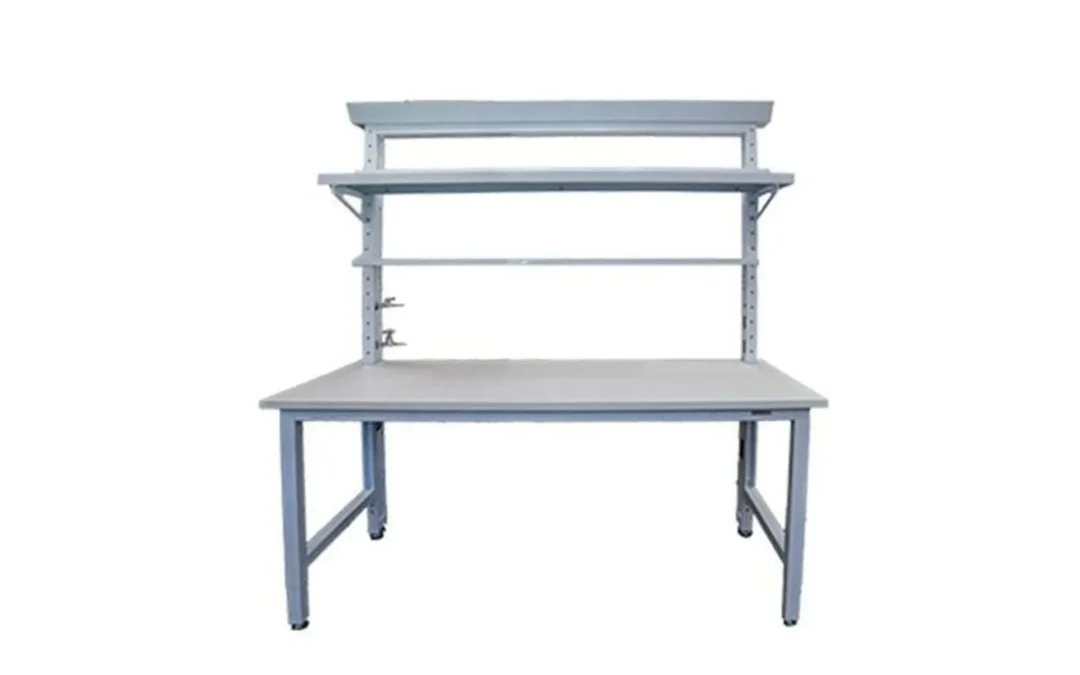
Chemical resistant countertops in an analytical or research lab fail for a specific reason, not because the catalog said “chemical resistant.” A solvent that beads off one surface can etch another. A spill wiped in a minute is a different test than the same spill left under a tray overnight. Facility planners, project engineers, and lab buyers should score the properties that match the reagents, the cleanup habit, and the instruments on that bench before they shortlist a surface.
Talk with a design specialist about lab work surface requirements.
This guide covers the properties to write into a specification. It does not rank stainless steel, epoxy resin, and phenolic resin. That comparison already lives in Workplace Modular Systems’ guide to choosing a chemical-resistant work surface. Use it after you know which properties the lab actually needs.
Which Chemical Resistant Countertops Properties Matter First?
Start with the work, not the material name. An analytical lab countertop sees acids, bases, solvents, stains, and heat from nearby equipment. A research bench may add longer dwell times because samples sit out during a run. Write those conditions down before you ask a supplier which surface to use.
The Scientific Equipment and Furniture Association publishes SEFA 3, the laboratory work surfaces standard. It covers work surfaces and sinks, including epoxy resin, high-pressure laminate, stainless steel, and solid phenolic. Ask for a current SEFA 3 chemical-resistance report for the exact surface you plan to buy. A generic “chemical resistant” line in a brochure is not that report.
Score these properties before you compare brands:
- Reagent classes: List the acids, bases, solvents, and stains used at that bench, not a generic lab chemical list.
- Dwell time: Note whether spills are wiped at once or can sit through a run or a weekend.
- Edge and containment: Decide if liquid must be held on the top or allowed to run off.
- Cleanability: Match the surface to the detergent, disinfectant, or solvent the lab already uses.
- Heat nearby: Flag hot plates, ovens, and instruments that radiate heat onto the top.
- Workflow fit: Confirm cutouts, instrument weight, and service access with the bench, not only the slab.
Workplace Modular Systems builds laboratory workstations in Londonderry, New Hampshire, with several work surface families. Epoxy resin is described as the option with the greatest chemical and heat resistance in that portfolio, for heavy-duty laboratory use. Phenolic resin is described as offering moderate chemical and heat resistance. Plastic laminate is the general-purpose top, with a chemical-resistant laminate available. Those are catalog facts. They are not a substitute for a reagent list from the lab.
How Should You Test Resistance Against the Lab’s Reagents?
A surface can pass a published chart and still fail on your bench. Published tests use a fixed set of reagents, a set volume, and a set time. Your method may use a different concentration, a different solvent blend, or a spill that sits longer because the instrument cannot be moved.
Build a short reagent log with the lab manager and EHS lead. For each chemical, record the name, the typical concentration, how often it is used, and how long a spill usually stays before someone wipes it. Separate “wiped within a minute” from “may sit under glassware.” That split changes which property matters.
Then read the supplier’s chemical-resistance report against that log. Look for the rating method, not only a pass mark. If your solvent or acid is missing, ask the manufacturer to comment on that reagent before you specify the top. Do not assume a neighboring chemical on the chart behaves the same way.
Keep three limits in view:
- Concentration: A dilute acid is not the same exposure as the concentrated stock bottle stored at the bench.
- Time: A spot test of one hour does not describe a weekend spill under a tray.
- Cleanup chemistry: The wipe solvent can mark a surface even when the sample chemical does not.
OSHA’s laboratory standard appendix covers the Chemical Hygiene Plan that employers use to protect lab workers, including ventilation and other protective measures. Read the OSHA laboratory standard appendix as a planning reference, not as a countertop specification. The surface still has to match the chemicals the plan says the lab uses.
Why Do Edges, Seams, and Drip Details Change Real Resistance?
The field of the countertop is only part of the exposure. Liquid leaves the top at the edge, the seam, and any cutout. A surface with strong chemical resistance can still let reagent reach the core, the floor, or the cabinet if the edge is open.
Workplace Modular Systems publishes these edge details for its laboratory surfaces:
- Epoxy resin: 1 inch thick, with a chamfer edge and a drip groove on the underside.
- Phenolic resin: 1 inch or 3/4 inch thick, with a slight bevel and a drip groove on the underside.
- Plastic laminate: 1 inch core covered with laminate and a backer, finished with PVC edging, in a round front or a square edge.
A drip groove is there to break a run of liquid before it travels down the face of the bench. It is not a spill tray. If the method produces large liquid releases, the project needs a containment strategy beyond the edge profile. That may be a marine edge, a raised lip, or a nearby sink, and it should be specified on purpose.
Seams and cutouts deserve the same attention. A joint between two tops, a grommet for cables, and a sink cutout all create edges the reagent can enter. Ask how those openings are sealed, and whether the sealant is rated for the same reagents as the top. Sinks with backsplashes are part of the same wet zone. Workplace Modular Systems offers laboratory and industrial sinks for that duty. Specify the sink material with the countertop, not as a later add-on.
Also check what sits under the top. A drip that clears the edge can still land on a drawer, a power strip, or stored bottles. The edge detail only works if the zone below it is planned.
How Do Cleaning and Heat Exposure Affect the Surface?
Chemical resistance and cleanability are related, but they are not the same property. A non-porous surface is easier to wipe. It can still stain or dull if a spill sits, or if the daily cleaner is harsher than the sample chemistry.
Write the cleaning method into the specification. Name the detergent or disinfectant, how often the top is wiped, and whether the lab uses a solvent wipe after a spill. If the surface will be cleaned between users on a shared analytical bench, short dwell and easy wiping matter as much as the published reagent chart.
Heat is the other silent failure. Instruments, hot plates, and drying steps can warm a top even when nobody sets a beaker down hot. Workplace Modular Systems describes epoxy resin as having the greatest heat resistance in its surface portfolio, and phenolic resin as having moderate heat resistance. Use those statements as a starting sort, then confirm the temperature the lab actually produces.
Ask the instrument vendor where heat leaves the chassis. A vent aimed at the countertop is a different load than a vent aimed at the room. If a hot plate is part of the method, say so. Do not leave “lab use” as the only heat note on the spec.
| Property to score | What to record | Why it changes the spec |
|---|---|---|
| Reagent class. | Acids, bases, solvents, and stains used at the bench. | A chart pass on the wrong chemical does not protect the top. |
| Dwell time. | Wiped at once, or left through a run. | Long contact is a harder test than a quick wipe. |
| Edge and seam. | Chamfer, bevel, drip groove, cutouts, and sink joint. | Liquid leaves the field of the top at these points. |
| Cleaning method. | Detergent, disinfectant, or solvent wipe. | The cleaner can mark the surface on its own. |
| Nearby heat. | Hot plates, ovens, and instrument exhaust. | Heat resistance is separate from chemical resistance. |
| Instrument fit. | Weight, cutouts, service side, and utilities. | The slab has to live on a bench the instrument can use. |
How Should the Countertop Fit Instruments and Daily Workflow?
An analytical countertop is part of a workstation. The surface can be chemically suitable and still be the wrong piece of infrastructure if the instrument does not fit, the service side is blocked, or the top cannot carry the load.
Match the surface decision to the instrument layout. Mass spectrometers, liquid chromatography, and gas chromatography need clear space, utility paths, and a frame rated for the load. Workplace Modular Systems builds mass spectrometry workstations for that class of equipment, with integrated space for chromatography gear. A separate gas chromatography bench specification guide covers clearances, utilities, and service access. Use those pages for the instrument layout. Use this page for the countertop properties.
Walk the workflow with the people who run the bench:
- List each instrument, its footprint, its weight, and the side technicians must reach.
- Mark where bottles, waste, and wipes sit during a normal run.
- Note cable and tubing cutouts so the edge seal is part of the surface spec.
- Confirm the frame load and whether the bench is stationary or mobile.
- Decide which surface family to request samples for, using the property scores above.
Laboratory applications at Workplace Modular Systems include clinical and life science setups, instrumentation benches, and pharmaceutical environments. The laboratory workstations and casework overview shows those configurations. If the project is still choosing a whole bench, start there, then return to the surface properties on this page.
Static-control laminate is a different requirement. Workplace Modular Systems offers an ESD laminate with a factory ground bolt for areas where devices are built, tested, or inspected. That surface answers an electrical question. Do not treat it as the answer to a harsh-reagent question. If the bench does both, say so in the spec and confirm both properties.
What Should the Specification Say Before You Request Pricing?
A useful specification is short and specific. It lets a manufacturer quote the right top instead of a generic chemical-resistant slab. Include the bench size, the surface family you want priced, the edge style, and the reagent log. Add the cleaning method and any heat source. Attach the instrument list and the cutouts.
Ask for these items in the quote package:
- The surface thickness and edge profile, including any drip groove.
- A current chemical-resistance report, and a note on any reagent missing from it.
- How cutouts and sink joints are sealed.
- The work-surface warranty term. Workplace Modular Systems states a 5-year warranty on work surfaces.
- Sample chips of the color you can actually order, not only a rendering.
Color and thickness are specification choices, not decoration. Epoxy resin from Workplace Modular Systems is offered in epoxy black, with other colors by special order, at 1 inch thick. Phenolic resin is offered in more than one color, including phenolic black, at 1 inch or 3/4 inch. Confirm the color and thickness against the sample program before the purchase order.
If the lab will change methods often, say that too. A modular bench can take a new surface or a new accessory layout later. That is a planning point for facilities, not a promise that every future reagent will suit today’s top. Revisit the reagent log when the method changes.
Frequently Asked Questions
What does chemical resistant mean on a lab countertop?
It means the surface was tested against a stated set of reagents for a stated time. It does not mean every chemical in the lab is safe on that top. Ask for the test method and match it to the reagents and dwell times at your bench.
Is epoxy resin always the right analytical lab surface?
No. Workplace Modular Systems describes epoxy resin as the surface with the greatest chemical and heat resistance in its portfolio, which makes it the usual starting point for harsh reagents. Phenolic resin, chemical-resistant laminate, or stainless steel can still be the better fit when the reagent list, heat load, or cleaning method is milder or different. Score the properties first.
Do edge style and sink cutouts affect chemical resistance?
Yes. Liquid leaves the top at edges, seams, and cutouts. A drip groove slows a run down the face of the bench. It does not replace a sealed cutout or a sink specified for the same reagents.
Should instrument weight be part of the countertop decision?
Yes. The surface and the frame work together. A chemically suitable top on an under-rated bench is still the wrong specification. Confirm instrument weight, service access, and utilities with the workstation design.
Plan the Surface With the People Who Run the Lab
Bring the reagent log, the cleaning method, and the instrument list to the same review. Chemical resistant countertops earn their place when those three inputs agree. Workplace Modular Systems can price a laboratory workstation once the surface family, edge, and cutouts are named.
Request a workstation quote or call 800.258.9700 to review the surface with a design specialist.